


Load Classes & Selection Principles for FRP Platform Grating
Corrosion‑Resistant, Insulated, Lightweight – How to Choose Safe and Reliable FRP Grating for Your Corrosive Environment?
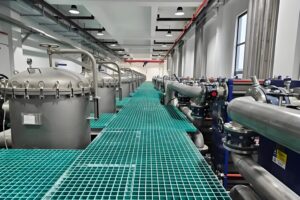
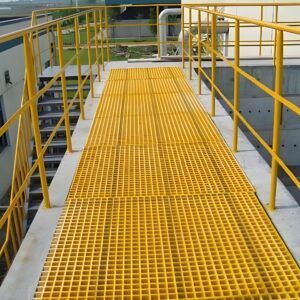
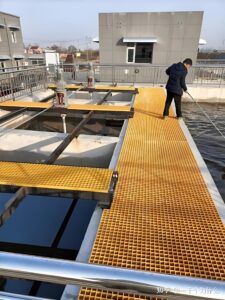
FRP (Fiberglass Reinforced Plastic) platform grating offers excellent chemical corrosion resistance, electrical insulation, light weight (approx. 1/4 density of steel), flame retardancy, and maintenance‑free operation. It is widely used in electroplating workshops, chemical plants, offshore platforms, wastewater treatment plants, and substations. Unlike metal grating, the load capacity of FRP grating depends not only on bar height and pitch but also on resin type, mesh size, and grit coating.
This article systematically introduces load class definition, influence of resin type, selection principles, and calculation examples for FRP platform grating.
1. Load Classes for FRP Platform Grating
Based on application and load magnitude, we divide FRP platform grating into five load classes. Note that recommended spans for FRP are significantly smaller than for steel.
| Load Class | Design Load (kN/m²) | Reference Load (t/m²) | Typical Application |
|---|---|---|---|
| Light | ≤ 1.0 | ≤ 0.10 | Personnel walkways, indoor light maintenance platforms |
| Light-Medium | 1.5 – 2.5 | 0.15 – 0.25 | Wastewater treatment walkways, general industrial access |
| Medium | 2.5 – 4.0 | 0.25 – 0.40 | Chemical plant operating platforms, electroplating walkways |
| Heavy | 4.0 – 5.5 | 0.40 – 0.55 | Light equipment platforms, offshore platforms (closer supports) |
| Extra Heavy | > 5.5 | > 0.55 | Not recommended – use steel grating instead |
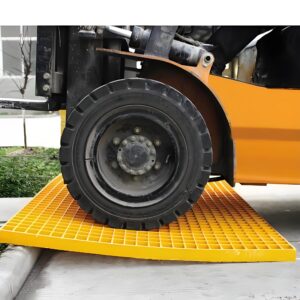
Important: The load capacity of FRP grating is significantly affected by resin type, mesh size, and ambient temperature. For frequent forklift traffic or heavy equipment areas, use hot-dip galvanized steel or stainless steel grating.
2. Influence of Resin Type on Load Performance
The corrosion resistance, temperature resistance, and flame retardancy of FRP grating depend mainly on the resin type. Different resins also affect long‑term creep behavior.
| Resin Type | Corrosion Resistance | Max Temp | Relative Strength | Suitable Load Scenarios |
|---|---|---|---|---|
| Orthophthalic Polyester | Fair | ≤80°C | Baseline | Indoor dry, mild corrosion, light loads |
| Isophthalic Polyester | Good | ≤90°C | 1.1x | Wastewater, general chemical, light‑medium loads |
| Vinyl Ester | Excellent | ≤110°C | 1.2x | Electroplating, strong acids/alkalis, medium‑heavy loads |
| Phenolic | Excellent (solvent resistant) | ≤150°C | 1.15x | High fire safety, heavy loads |
Core recommendation: For most corrosive environments, isophthalic polyester is sufficient. For electroplating and strong acids/alkalis, use vinyl ester. For high fire safety, use phenolic. Vinyl ester has the lowest creep under long‑term load, making it best for heavy applications.
3. Common FRP Grating Specifications & Load Capacity
The load capacity of molded FRP grating depends mainly on mesh size and bar height. The table below shows recommended spans under uniform load (deflection control L/150).
| Model | Mesh Size (mm) | Bar Height (mm) | Max Span (Load ≤2 kN/m²) | Max Span (Load ≤4 kN/m²) |
|---|---|---|---|---|
| 25×25×25 | 25×25 | 25 | 600 mm | 450 mm |
| 38×38×25 | 38×38 | 25 | 750 mm | 550 mm |
| 38×38×30 | 38×38 | 30 | 900 mm | 700 mm |
| 38×38×38 | 38×38 | 38 | 1100 mm | 850 mm |
| 50×50×50 | 50×50 | 50 | 1200 mm | 950 mm |
Note: Data above is based on isophthalic polyester resin. Vinyl ester has similar performance. Always perform deflection verification for your specific load.
4. Selection Principles for FRP Platform Grating
Principle 1: Deflection control is critical
FRP has an elastic modulus of approximately 10 GPa (about 1/20 of steel), so deflection is much larger than metal. Recommended design deflection ≤ L/150 (e.g., for span 900mm, deflection ≤6mm) to avoid a “bouncing” feel and long‑term creep.
Principle 2: Resin type determines corrosion resistance and long‑term performance
- Mild acids/alkalis, dry environments → Orthophthalic or Isophthalic polyester
- Strong acids, alkalis, oxidizing media → Vinyl ester
- Organic solvents, high temperature, fire safety → Phenolic
Principle 3: Grit coating has minor impact on load
Grit coating adds about 10-15% to self‑weight but has little effect on load capacity. In wet, oily environments, grit coating is a safety standard and should not be sacrificed.
Principle 4: Effect of ambient temperature
FRP strength decreases at high temperatures. When ambient temperature exceeds 50°C, reduce load or use high‑temperature resins (e.g., phenolic).
Principle 5: Mesh size selection
| Mesh Size | Features | Recommended Application |
|---|---|---|
| 25×25 | Better fall prevention, higher capacity | High‑traffic areas, around precision equipment |
| 38×38 | Best overall performance, most common | Most industrial platforms |
| 50×50 | Fast drainage, lighter weight | High drainage requirements, light walkways |
5. Load Class vs. Recommended Models (FRP Grating)
The table below assumes isophthalic polyester resin, deflection limit L/150, and grit‑coated surface.
| Load Class | Design Load (kN/m²) | Recommended Model | Max Recommended Span | Suitable Resin |
|---|---|---|---|---|
| Light | ≤ 1.0 | 25×25×25 | 600 mm | Ortho/Iso |
| Light-Medium | 1.5 – 2.5 | 38×38×25 | 750 mm | Isophthalic |
| Medium | 2.5 – 4.0 | 38×38×30 | 900 mm | Iso/Vinyl ester |
| Heavy | 4.0 – 5.5 | 38×38×38 or 50×50×50 | 850 mm (38×38×38) / 950 mm (50×50×50) | Vinyl ester/Phenolic |
| Extra Heavy | > 5.5 | Not recommended | – | Use steel grating |
Span note: The spans above refer to the clear distance between support beams. If your actual span exceeds the recommended value, add more supports or choose a higher‑capacity model.
6. Selection Calculation Example
Project background: An electroplating workshop needs an operating platform for routine inspection, with occasional placement of small chemical drums (total weight approx. 300 kg). Support beam spacing is 800 mm.
Step 1 – Determine load class
Personnel + small drums → estimated uniform load approx. 3.0 kN/m² → falls under “Medium” class.
Step 2 – Initial selection from table
Medium class recommends 38×38×30 model with max span 900mm. Actual span 800mm is less than 900mm – initially acceptable.
Step 3 – Consider environmental factors
Electroplating workshop has strong acids and oxidizing media → vinyl ester resin is mandatory.
Step 4 – Anti‑slip requirement
Floor often has liquid spills → grit‑coated surface required.
Step 5 – Final recommendation
Choose 38×38×30 vinyl ester resin grit‑coated FRP grating. Color: yellow (standard) or grey.
Deflection estimate: Under 3.0 kN/m² and 800mm span, deflection is approximately L/200 ≈ 4mm, well below L/150 ≈ 5.3mm – safe.
7. Common Selection Mistakes & How to Avoid Them
| ❌ Mistake | Consequence | ✅ Correct Practice |
|---|---|---|
| Using steel grating span tables for FRP | Excessive deflection, unstable walking | Use FRP‑specific span table; control deflection to L/150 |
| Using orthophthalic resin in strong acid environments | Grating corrosion failure | Choose vinyl ester or phenolic based on media |
| Ignoring self‑weight of grit coating | Slight overload | Add 5–10% margin in design |
| Using standard resin in high‑temperature areas | Strength loss, deformation | Use phenolic resin or reduce load |
| Not sealing cut edges | Fiber exposure, moisture absorption | Seal all cut edges with resin |
8. FRP vs. Metal Grating – Quick Comparison
| Feature | FRP Grating | Hot-Dip Galvanized Steel | Aluminum Grating |
|---|---|---|---|
| Corrosion resistance | ★★★★★ (strong acids/alkalis) | ★★★ | ★★★★ |
| Electrical insulation | ★★★★★ (non‑conductive) | ★ | ★ |
| Weight | ★★★★ (1/4 of steel) | ★★ | ★★★★★ |
| Load capacity | ★★ | ★★★★★ | ★★ |
| Maximum span | Smaller | Large | Smaller |
| Flame retardant | Optional (V‑0) | Non‑combustible | Non‑combustible |
| Typical application | Highly corrosive, insulated | Heavy load, general industry | Light load, aesthetic, marine |
9. Summary – Four‑Step Selection Method
- Determine load → calculate design load (kN/m²) based on application
- Measure span → support beam spacing L (mm)
- Select resin type → based on chemical media and ambient temperature
- Choose model from table → ensure recommended span ≥ actual span under your load
If you already know your platform dimensions and load but are unsure which FRP model is suitable, please contact our engineers. We can provide a free deflection calculation sheet and resin selection recommendation to help you make the best decision.