

Load Classes & Selection Principles for Aluminum Platform Grating
Lightweight & Corrosion‑Resistant – How to Choose Safe and Economical Aluminum Grating for Your Industrial Platform?
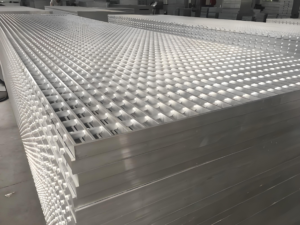
Aluminum platform grating offers advantages such as light weight (approx. 1/3 of steel), natural corrosion resistance, non‑magnetic properties, and the ability to be anodized or powder coated. It is widely used in food processing, chemical plants, marine engineering, and wastewater treatment. However, aluminum has an elastic modulus about 1/3 that of steel, resulting in greater deflection under the same load. Therefore, span and load must be controlled more strictly during selection.
This article systematically introduces load class definition, material characteristics, selection principles, and calculation examples for aluminum platform grating.
1. Load Classes for Aluminum Platform Grating
Based on application and load magnitude, we divide aluminum platform grating into five load classes:
| Load Class | Design Load (kN/m²) | Reference Load (t/m²) | Typical Application |
|---|---|---|---|
| Light | ≤ 1.5 | ≤ 0.15 | Personnel walkways, indoor light maintenance platforms |
| Light-Medium | 2 – 3 | 0.2 – 0.3 | Food plant operating platforms, general industrial walkways |
| Medium | 3 – 5 | 0.3 – 0.5 | Chemical plant light platforms, wastewater treatment walkways |
| Heavy | 5 – 7 | 0.5 – 0.7 | Occasional light forklift traffic, equipment access platforms |
| Extra Heavy | > 7 | > 0.7 | Not recommended – use steel grating instead |
Important: The load capacity of aluminum grating is approximately 1/3 that of carbon steel grating of the same size. For frequent forklift traffic or heavy equipment areas, use hot-dip galvanized steel or stainless steel grating.
2. Influence of Aluminum Material Properties on Selection
| Property | Value | Impact on Selection |
|---|---|---|
| Density | 2.70 g/cm³ (1/3 of steel) | Lightweight, easy installation, lower support requirements |
| Elastic Modulus | 69 GPa (1/3 of steel) | Deflection ~3x that of steel under same load → strictly control span |
| Yield Strength | 6061-T6 ≥240 MPa | Sufficient strength, but stiffness is the limiting factor |
| Corrosion Resistance | Natural oxide film | No galvanizing needed – suitable for humid, mild acid/alkali, marine atmospheres |
| Surface Treatment | Anodizing / powder coating | Custom colors, improved corrosion resistance and aesthetics |
Key conclusion: Selection of aluminum grating is governed by stiffness (deflection), not strength. Therefore, the design deflection limit should be stricter than for steel (recommended L/150 or less).
3. Common Aluminum Alloy Grades
| Grade | Tensile (MPa) | Yield (MPa) | Typical Application |
|---|---|---|---|
| 6061-T6 | ≥260 | ≥240 | General industrial platforms – high strength, good value |
| 6063-T5 | ≥205 | ≥170 | Architectural, light walkways – smooth surface |
| 5083-H112 | ≥290 | ≥215 | Marine environments – seawater pitting resistance |
Recommendation: For most industrial platforms, choose 6061-T6. For coastal or marine environments, choose 5083.
4. Load Class vs. Recommended Models (Aluminum)
The table below assumes 30mm bar pitch and anodized finish. Note that recommended spans for aluminum are significantly smaller than for steel.
| Load Class | Design Load (kN/m²) | Recommended Bar Size | Recommended Model | Max Recommended Span |
|---|---|---|---|---|
| Light | ≤ 1.5 | 25×5 | G255/30/100 AL | 1000 mm |
| Light-Medium | 2 – 3 | 25×5 or 32×5 | G325/30/100 AL | 1000 mm |
| Medium | 3 – 5 | 32×5 | G325/30/100 AL | 1200 mm |
| Heavy | 5 – 7 | 40×5 | G405/30/100 AL | 1200 mm (verify deflection) |
| Extra Heavy | > 7 | Not recommended | – | Use steel grating |
Span note: The “Max Recommended Span” above is based on keeping deflection within L/150 under the corresponding load. Always perform deflection verification for your specific load.
5. Selection Principles for Aluminum Platform Grating
Principle 1: Stiffness control over strength
Due to aluminum’s low elastic modulus, deflection is often the limiting factor. Recommended design deflection ≤ L/150 (e.g., for span 1200mm, deflection ≤8mm) to avoid a “bouncing” feel when walking.
Principle 2: Bar height contribution to stiffness
Bar height affects moment of inertia by the cube (I ∝ h³). Increasing bar height is the most effective way to control deflection.
| Bar Height (mm) | Relative Inertia (25mm = 1.0) | Recommended Max Span (Load ≤3 kN/m²) |
|---|---|---|
| 25 | 1.0 | ≤ 1000 mm |
| 32 | 2.1 | ≤ 1200 mm |
| 40 | 4.1 | ≤ 1500 mm |
| 50 | 8.0 | ≤ 1800 mm (verify) |
Principle 3: Bar pitch selection
| Bar Pitch | Features | Recommended Application |
|---|---|---|
| 30mm | Higher load capacity, better fall prevention | High‑traffic areas, light equipment platforms |
| 40mm | More economical, faster drainage | Walkways, general access |
Principle 4: Dynamic load factor
For dynamic conditions such as occasional forklift traffic or frequent personnel movement, multiply static load by a dynamic factor of 1.3–1.5.
Principle 5: Environment and surface treatment
- General industrial: 6061-T6 + anodizing (standard)
- Marine / high salt spray: 5083 + anodizing (thick)
- Architectural / food plants: 6063 + powder coating (RAL colors)
6. Selection Calculation Example
Project background: A food processing plant needs an operating platform for routine inspection, with occasional light hand trucks (total weight 200 kg). Support beam spacing is 1100 mm.
Step 1 – Determine load class
Personnel + hand truck → estimated uniform load approx. 2.5 kN/m² → falls under “Light-Medium” class.
Step 2 – Initial selection from table
Light-Medium class recommends G325/30/100 AL (32×5 bars) with max span 1000mm. Actual span 1100mm is slightly larger – verification needed.
Step 3 – Deflection verification
For 32×5 bars at 30mm pitch, under 2.5 kN/m² and span 1100mm, deflection is approx. L/170 ≈ 6.5mm, which is less than L/150 (7.3mm) – acceptable.
Step 4 – Final recommendation
Choose G325/30/100 AL (32×5 bars, 30mm pitch), anodized.
For higher slip resistance, choose serrated model G325/30/100F AL.
7. Common Selection Mistakes & How to Avoid Them
| ❌ Mistake | Consequence | ✅ Correct Practice |
|---|---|---|
| Using steel grating span tables for aluminum | Excessive deflection, unstable walking | Use aluminum‑specific span table; control deflection to L/150 |
| Ignoring dynamic load factor | Increased deformation over time | Add 1.3–1.5 factor for dynamic conditions |
| Placing bearing bars parallel to supports | Capacity drops by >80% | Bearing bars must be perpendicular to supports |
| Using aluminum in heavy‑load areas | Platform failure | For >7 kN/m², use steel grating |
| Direct contact between aluminum and carbon steel | Galvanic corrosion | Use insulating washers or stainless steel fasteners |
8. Quick Comparison – Aluminum vs. Steel Grating
| Feature | Aluminum Grating | Hot-Dip Galvanized Steel Grating |
|---|---|---|
| Weight | ★★★★★ (1/3 of steel) | ★★ |
| Corrosion resistance | ★★★★ (natural) | ★★★ (coating dependent) |
| Load capacity | ★★ (~1/3 of steel) | ★★★★★ |
| Maximum span | Smaller | Larger |
| Cost | ★★★ | ★★★ (slightly lower) |
| Typical application | Light load, corrosive, aesthetic | Heavy load, general industry |
9. Summary – Four‑Step Selection Method
- Determine load → calculate design load (kN/m²) based on application
- Measure span → support beam spacing L (mm)
- Initial selection from table → choose bar height based on load class and span
- Deflection verification → ensure actual deflection ≤ L/150; increase bar height or add supports if needed
If you already know your platform dimensions and load but are unsure whether aluminum is suitable, please contact our engineers. We can provide a free deflection calculation sheet and CAD drawing to help you make the best decision.